United Provinces of Western Canada
Honour the Past. Build the Future. Share your Voice.
 West.svg) Should Western Canada become an independent nation?
Should Western Canada become an independent nation?
Definition of Western Canada
The United Provinces of Western Canada is a conversation centred on the following geographic and civic framework:
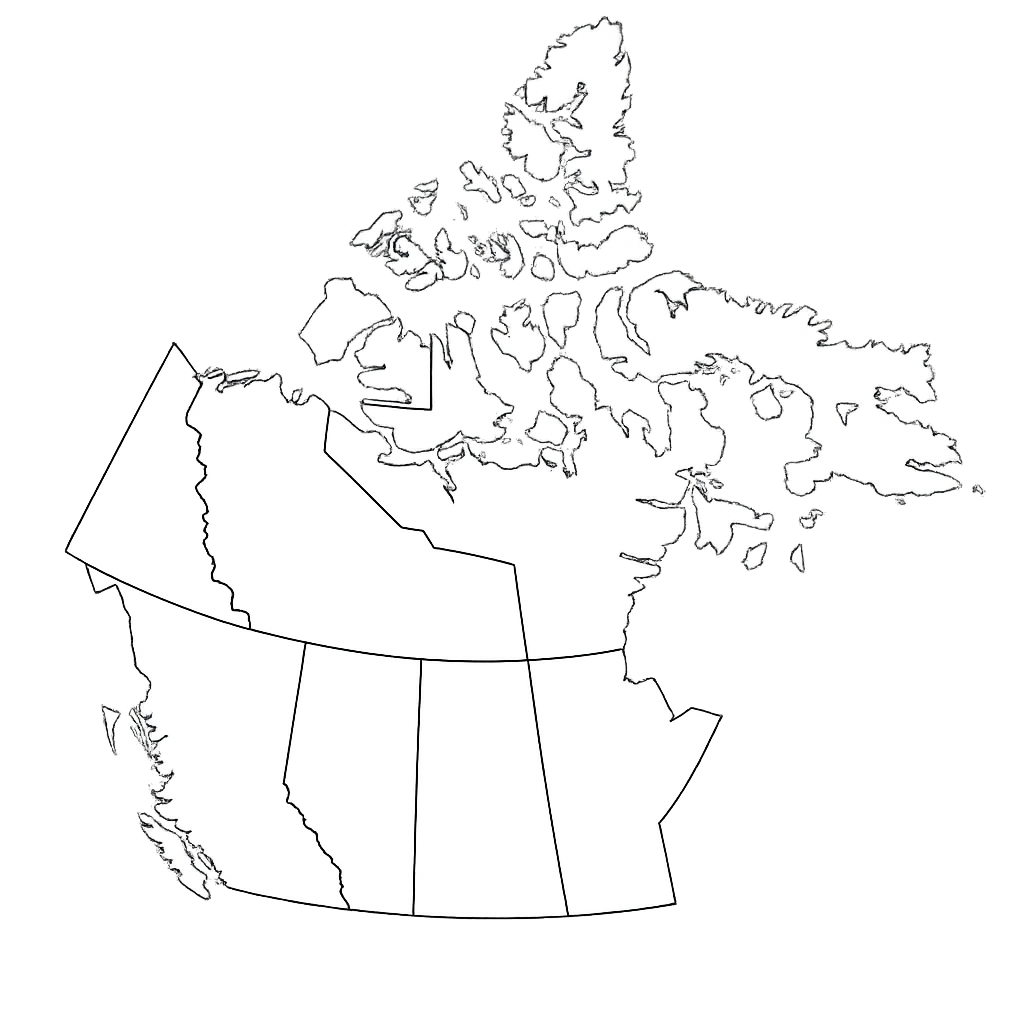
- •Western Canada consists of British Columbia, Alberta, Saskatchewan, and Manitoba.
- •Welcoming Yukon, Northwest Territories, and Nunavut as partners in Western Canada's future.
- •Welcoming all First Nations, Inuit, and Métis peoples as an essential part of Western Canada, and welcoming their voices as part of this conversation.
Did you know?
- •It is estimated that federal fiscal equalization and redistribution transfers approximately $1,500 per Western Canadian each year—approximately $6,000 annually for a family of four.
- •Western Canada (BC, AB, SK, MB, YT, NT, NU) is home to approximately 13.6 million people (33%), while provinces east of Manitoba are home to approximately 28.0 million people (67%).
- •Western Canada elects 111 of Canada's 343 Members of Parliament (32%), while provinces east of Manitoba elect 232 MPs (68%).
West: 111 MPs | East: 232 MPs - •Western Canada has 27 of Canada's 105 Senate seats (26%), while Ontario, Quebec, and the Atlantic provinces have 78 Senate seats (74%).
West: 27 Senate Seats | East: 78 Senate Seats
What is economic sovereignty?
Economic sovereignty is the ability of a nation to produce, trade, and make economic decisions that best serve the interests of its citizens.
Western Canada | Estimated National Profile
| Metric | Value | Approx. Global Rank |
|---|---|---|
| GDP (2026 est.) | ~$1.2 trillion CAD | Top 20 |
| GDP per Capita | ~$95,000 CAD | Top 5 globally |
| Population | ~13.6 million | ~75th |
| Land Area | ~6.3 million km² | 2nd largest globally |
| Natural Resources | Oil, gas, uranium, potash, timber, agriculture | Global resource power |
| Trade Profile | Net-exporting region; strong trade with the United States for mutual economic benefit | Major global supplier |
Includes: British Columbia, Alberta, Saskatchewan, Manitoba, Yukon, Northwest Territories, Nunavut, and participating Indigenous communities.
Western Canada possesses the land, resources, workforce, and economic capacity to operate as one of the most capable mid-sized economies in the world. This platform explores how those strengths could support Western Canada's long-term future.
A Note to Albertans
As Alberta considers its future, we invite Albertans to consider a broader vision. The United Provinces of Western Canada is founded on the belief that our greatest strength comes from working together.
By uniting British Columbia, Alberta, Saskatchewan, Manitoba, Yukon, Northwest Territories, and Nunavut, we can build a nation with greater economic strength, broader opportunity, and a stronger voice than any province could achieve alone.
The Vision
The United Provinces of Western Canada is a citizen-led initiative that explores how greater economic independence, democratic accountability, and regional cooperation could strengthen the long-term future of Western Canada. It is not intended as a rejection of Canada's history, but as a conversation about its future.
Any future Western framework envisioned by this platform is founded on the principle of equal citizenship under the law.
This includes First Nations, Inuit, and Métis peoples across Western Canada, including but not limited to Cree, Blackfoot Confederacy, Dene, Coast Salish, Haida, Inuit, Métis, and many other Indigenous nations.
All participation, inclusion, and governance will be determined through lawful, democratic processes grounded in transparency, stability, and mutual respect.
Charter & Participation
The United Provinces of Western Canada is a civic engagement platform founded on the principles of equal citizenship, democratic participation, and the freedoms protected by the Canadian Charter of Rights and Freedoms.
It does not represent any government, province, or institution. Its purpose is to encourage informed public discussion by collecting the views of Western Canadians through polls, research, and public participation.
Participation is voluntary, respectful, and intended to contribute to an open democratic conversation grounded in Canadian law.
“Everyone has the freedom of thought, belief, opinion and expression, including freedom of the press and other media of communication.”
— Section 2(b), Canadian Charter of Rights and FreedomsOur Objective
This platform exists to explore Western Canada's future through respectful, lawful, and democratic public participation.
Our goal is to build meaningful public participation across Western Canada and present the results to elected officials. As participation grows, we aim to demonstrate public support for a lawful and democratic referendum on Western Canada's future.
Should Western Canada become an independent nation?